AI in 2026 - What to Make of All The Hype
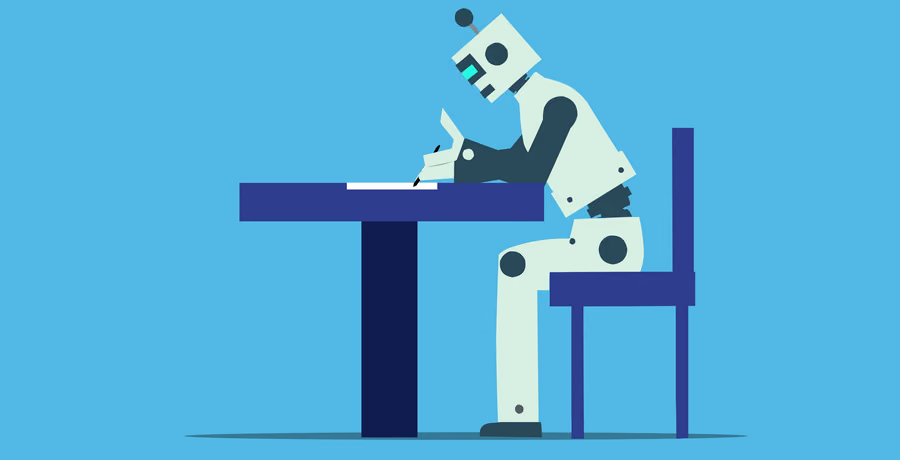
2026 has to be the year of Artificial Intelligence (AI). We hear about all the things it will do, what it does now, and how, eventually, it will be “useful” in your phone and perhaps replace the personal assistant. But, what are the realities of this new and super-hyped technology? I wanted to dig deeper and understand from some noteworthy people what they think about what’s coming and what this is doing to us.
The words “flimsy bullshit” rang in my head as I read page 65 of Cory Doctorow’s The Reverse Centaur’s Guide to Life After AI: How to Think About Artificial Intelligence―Before It’s Too Late. Sure, Artificial Intelligence (AI) chatbots and the like are broadly useful tools, but more that that they’re made up of a bunch of flimsy bullshit too. Doctorow is one of a few different angles on AI that help me find a little more context It’s moving fast too, so everything I’m reading is published this year.
First thing, it’s Doctorow’s centaur reference. He’s primarily concerned with labour when talking about AI, and in this context, the centaur is a worker who is augmented by machines, while the reverse centaur has to do the bidding of the machines (or AI). It’s an appropriate comparison when so many conversations about AI are concerned with what jobs will be “replaced” in the future by the technology.
Just like he did in his book Enshittification, Doctorow elucidates the issues we’re about to face with AI, and enshittification is perhaps just one endpoint of many. His focus on labor seems appropriate given that it appears to be the “problem” AI is positioned to solve or disrupt.
Never forget that you aren’t the target for AI hype-investors are.
It’s a big question: If an AI chatbot could replace a worker outright, should it? Doctorow goes much deeper into what he calls an “accountability sink,” which is when a poor sap is the only one left to do the impossible task of verifying the AI’s work, fails and is then shitcanned and takes the blame. Rinse and repeat. That’s a horror story. If Doctorow is right and bosses would jump at such a scenario, that’s not a happy thought. But, clearly Doctorow is a critic of AI and capitalistic proclivities here.
I like how Benjamin Hollon responds to being too-often questioned on AI:
But when you ask me that awful, misguided question as if you’re equating my writing with that trash, it makes me wonder if my writing actually matters. I begin to lose motivation to write. I begin wondering how truthful it is anymore to call myself a writer when I dread putting pen to paper.
Like Benjamin above, I’m regularly asked what I think of AI. The question is no annoyance to me, but the velocity of these changes are coming for us all. My stock response is “AI is a tool like anything else. When the hype ends, we see how it can really be used.” But, I do see a growing backlash to all this1. Is this all part of a new luddite movement? Is AI finally the thing that makes workers rise to a new wave of protections and unions? only time will tell, but the wonderful newsletter Blood in the Machine gives us some great insights into what’s already happening.
Doctorow makes a convincing argument that AI training is not a violation of copyright law. Scraping data is legal, counting, say, the number of verbs in the text is also legal, and finally - since the use of this data to create new works is code, and code is free speech under the US first amendment 2. This of course is outside of whether the stuff is any good or how this might displace workers.
His main focus, however, is the destructive economics of AI and he minces no words when he calls it a bubble:
Tech bubbles are surprisingly easy to generate, thanks to something economists call “the Byzantine premium.” That’s the extra value that investors place on an asset that they don’t understand. They assume that any pile of shit of sufficient size must have a pony under it somewhere.
This bubble, he says, will burst like all bubbles do. How is this going to look? If his numbers are accurate, painful:
Remember: seven giant AI companies account for 35 percent of the U.S. stock market. Amputating 35 percent of the market is going to destroy a ton of innocent bystanders, including people whose retirement savings are invested in index funds, considered the safest of all safe bets. We’re talking about a crash that will put 2008 in the shade and meet or exceed the pandemic sell-off.
That it’s a bubble made of a turd mountain is self evident for him and he makes it clear it enough that it should be the same for the rest of us. But, when Doctorow gets to “agentic” AI, which of course he thinks is snake oil, he says it doesn’t (and won’t) work because:
Companies don’t want you to have good information about their products and services, their prices and costs, because when they know things you don’t, they can make more money off of you.
And, with news that Facebook’s Meta is about to start selling “excess” AI capacity, this may be the first pop of the meta-phoric bubble. We’re also learning that human writing is detectable and distinct, so maybe AI shouldn’t be writing your next great novel.
Even though Doctorow is a sceptic, he still highlights good uses for something like a chatbot. He imagines an AI therapist that sits entirely on one’s device with no data connection to outside services. There’s no privacy risk because the personal conversations stay local. I think of it, and it’s sound like a great evolution of something like journaling.
Daniel Foch, who’s made a name for himself has a big proponent and user of agentic AI in the Canadian real estate space summed it up nicely when I asked him what his monthly token spend is. Sure, $1,000 a month is a lot of money by any objective level, but it’s his addition of labour savings that brings home what Doctorow has been saying about the story that “AI salesmen” have been selling:
I pay about $1k a month and it saves me about $5k in labour costs
— Daniel Foch (@danielfoch) July 4, 2026
Joanna Stern, a tech journalist and someone I can only assume is a tech evangelist over that of a sceptic has taken a rosy approach to AI in her book I Am not a Robot: My Year Using AI to do (Almost) Everything. In the book she infuses her positive outlook on AI with a sort of curiosity that might be grating for some.
She doesn’t exactly skip the negatives of AI like “hallucinations,” but it’s more like reportage. The same with the myth of Artificial General Intelligence (AGI) and its possible dystopian future for mankind. She reports on it and separates herself from whether it’s true or not.
Joanna is also forthcoming about her breast cancer screening process and seems to willingly submit to the process of having AI diagnose her (with the help of a doctor, naturally). In her case the doctor seems like a centaur, commanding the AI to augment the job of finding a tumor. Joanna’s prose is uplifting - treating so much of this like a wonderful new frontier. Her willingness to try anything from robotaxis to AI fitness coaches. Her odyssey is filled with errors, occasional danger and stupid infinite loops. Through all of it, there were the familiar refrains “we [makers] don’t want to replace workers” and that AI was meant to “do the work the next generation won’t.” I don’t buy these talking points.
At this point it felt worthwhile to go back to the beginning, and this took me to Sebastian Mallaby’s book The Infinity Machine: Demis Hassabis, DeepMind, and the Quest for Superintelligence. This covers how the first artificial intelligence machine first took shape in 2010, that of Deepmind, covering more about its creators. The problem Hassabis and his compatriots were trying to solve were to create “programs that designed programs.” Hassabis and his supporters really drank the kool aid on bringing Reinforcement Learning (RL) to the AI space. I can picture trying to pitch angel investor Peter Thiel, while Ray Kurzweil’s worries about “the singularity” were on the lips of everyone at these conferences. It probably made for an insane mix of four out thoughts and grounded ambition.
But, they built from London, England and Toronto, Canada. They wanted to revolutionize computing, not replace labour. They wanted to create the “infinity machine” that would actually learn.
…all these elements of reinforcement learning were designed to achieve one thing. Complex environments allow for an infinity of possible actions; to learn by trial and error, the system needs a way of knowing which actions are worth trying. In order to tame infinity, in other words, an infinity machine has to develop algorithms that narrow the search for the best action.
The addition of RL or reinforcement learning in this in this mix is what makes all this eminently useful. The fact that one can now set a task and tell an “agent” to finish is brilliant, but to now be able to make larger plans and tell the AI “Don’t stop until the task is completed.” People are using these tools to guide them in making documents and building sheds. As you’ll see in another post, I used AI to write like me.
So, yes, this bubble is going to burst. Yes, machine learning is useful. Yes, resource usage is troubling. And when this bubble bursts, there will be a salvage operation leaving useful tools in its wake. In the meantime, mega companies are going to try and push AI monstrosities on us and fail in the process of appearing to grow. It is on us to be as clear-headed about AI as we can, embrace the usefulness of these technologies and be wary of those selling the “snake oil” of magical AGI that will (poorly) replace their workforce, because for some it will be you they are out to replace.
I do wonder if every single blog post I’ve written here could be given to an AI and, with a prompt “write a new article,” it does, and does it in my exact voice and writing style. My recent migration had me thinking a similar way. The question for me is not whether AI works (for what doesn’t will improve), but if it will make us better or worse. As a kid, I’d have nothing but a crappy AM-only radio and still listen to grainy sounding music. It was good enough for me. Will AI slop be “good enough” for all those without access to high fidelity data from the first world? As AI itself is bleeding into agents, and then loops of agents and then agents that compose music with each other, the future is exactly as unknown as it is wide open.
It seems to boil down to one thing: Will we be the centaur or the reverse centaur? We may have to fight for the former. I’m off to tweak my installation of OpenClaw.