Book: Beyond Good Enough by Karen Stintz
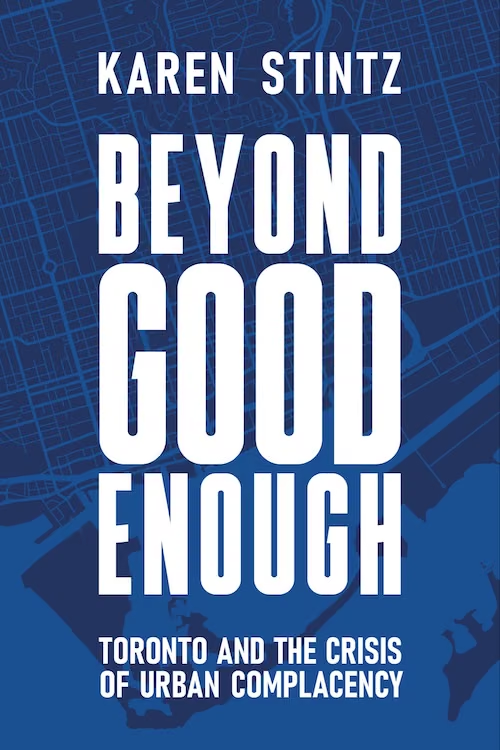
With a municipal election heading towards us fast, many are looking to Toronto as a flashpoint for Ontario’s largest issues. My approach when an election looms is to peer through the prism of a recently released book. Before the recent Provincial election I read Against the People: How Ford Nation Is Dismantling Ontario and offered my thoughts. This time around, I read former Toronto City Councillor Karen Stintz’s newly released book entitled Beyond Good Enough: Toronto and the Crisis of Urban Complacency.
As it happens, I stumbled into her September 15th book release event at the Younge and Eglinton Indigo store and met Karen briefly. She was nice enough to answer my one simple question: “What direction do you lean on the political spectrum?,” her answer was simply “Right.” With that, I picked up her book and she signed it for me with the inscription:
Kevin: I hope you enjoy the book and it leads to some good conversations. - Karen Stintz
Indeed Karen, if you do read this, I am doing what I can to have those conversations. Since the launch event was ending, there wasn’t much more time to stay and chat and so I was off to read her book.
Given the title and back cover blurb, it’s clear that Karen’s stated message is to critique the way the City of Toronto has been run and “reject mediocrity.” Since I’m someone who grew up in the city in the late 1980s through the early aughts and have recently returned, I feel as if I’m in a good position to understand and perhaps even support many of her points. The one thing I don’t want to do, however, is be overly political or tell you who to vote for.
She starts off on page 5 digging into DEI:
“The troubling reality of the privilege argument is simple: it divides people into those who can oppress and those who are oppressed. Those born with what the progressive left considers to be the sin of privilege are defined by their race and, therefore, only their express and repeated public atonement is sufficient to acknowledge their sin.”
This reads like someone who’s had that privilege but seems not to realize it. But, more than that, I think this characterization is wrong. For the underprivileged, I imagine they could care less about anyone’s atonement. They, like anyone else, want a better life and would hopefully break the cycle of struggles they face if given the chance (some do, despite the defeatist attitude of many around them). My read on this argument is always “DEI didn’t work because the wealth gap is bigger than ever,” but never do I hear from DEI-haters that it should be further refined, reformed or done better. It shows their cards: they just want it gone. Okay.
Her example of car thefts called on a serious example of theft and violence, but she undermines her argument by saying this was ignored because car owners were considered to be privileged (thus not worthy of being helped). Not only do I recall everyone taking this seriously across the country with even a province-wide task force, but, Karen, check out the Ontario Driver’s Handbook, wherein is clearly says driving is a privilege. Perhaps because of this seriousness, auto thefts are dropping1. The thing is, in the “third city” of Toronto, the one described in the book as poor, you’d be lucky to afford a car, much less have it stolen.
Then she shifts to drug treatment centers. She says:
They were designed for harm reduction-a clear, defensible goal under the auspices of public health. Then they became something else: distribution centers. The mission had shifted.
In a way these two things can be happening at once with no real shift, as she says. But when I hear these talking points it makes me think they’re saying the burden of dealing with still-living drug users as too annoying; and they’re a blight for the general public. In other words, it’s the visibility of them that needs to be corrected, not the underlying disease. The reaction never seems to be that we’re grateful to still have them alive to fight another day and need to meet these people where they are2 to get them healthy again. The reality is that one person saved from the horrors of drug use could be your sister or brother. The ones that don’t make it seem to be forgotten to all but the statisticians.
When she talks about parks and public spaces, Karen seemed to be all for the removal of encampments at Trinity Bellwoods Park in 2021. She cites the tragedy of the commons. But curiously she describes the public as “craving” green spaces, but no mention of anyone “craving” a safe place to go in the wake of COVID (shelters were not that). Perversely, the nebulous “public” was more important than the real people living in that park. This quote is telling:
People occupy these parks not merely for want of affordable homes; many grapple with mental illness or addiction, and permitting them to persist in such vulnerable conditions strips away their dignity while thwarting chances for mental and physical recovery. Others simply relish off-grid living as an escape from the law.
To her, there are but a few reasons a person lives in a park - the cheapskates, Druggies, criminals, and the generally horrible. No “good” person could be doing that. And, indeed, “dignity”:
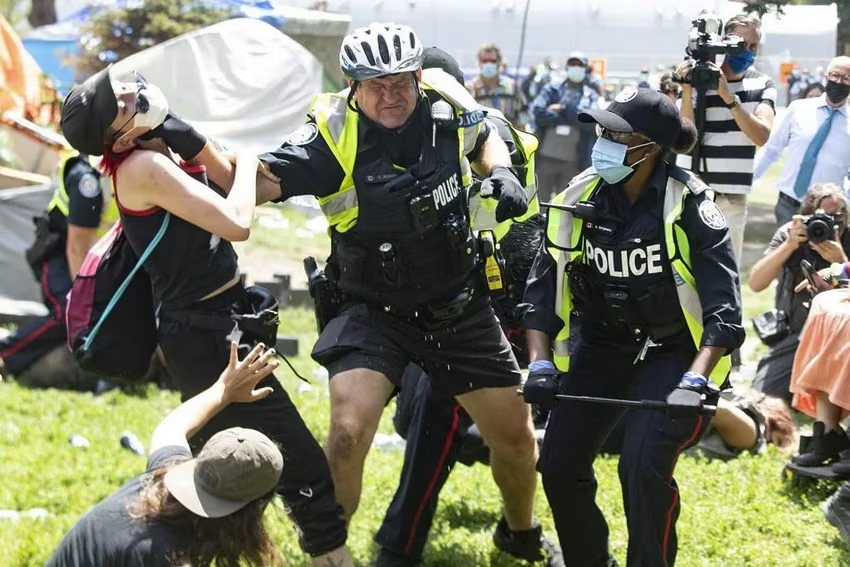
There seems to be a distinct “othering” that happens when the upper classes talk about the needs of people living in encampments3. But, beyond that there’s a clear need to minimize them to a basic caricature of needing “dignity” and a “path to housing.” But, the important reality is that everyone’s circumstance is often wildly different from another; just as their needs are also that complex. Let’s face it though, when the public craves green space, the violence the system is ready to dole out is a simple matter.
It just begs the question: Has Karen ever had to live in a shelter, much less during COVID? Does she possess the empathy needed to understand what that’s like? And did she ever ask encamped residents what they thought?
Karen is also against the renaming of Younge/Dundas square. I’m mostly ambivalent to it, but it’s laughable to me the idea that the square name change led to us “forgetting our past” or “declining revenue” - that square will be just fine no matter what the city calls it.
But like all of us writers, Karen would have a greatly improved her book with better editing and proofreading. There are some glaring mistakes like the one in the second paragraph of page 25. You find numerous repeated words in sentences and turn of phrases that are sure to alienate some readers. One such example happens as she mentions the Blue Jays World Series run, that “they united a country that had just recently remembered its pride in itself.” Yuck, that’s a word salad. All this is to say, as a card-carrying bad writer (working hard to be better), I know this can take a reader out of your narrative or, even worse, bore them.
As it turns out Beyond Good Enough is a bit of a muddled mess. I’m not clear what Karen’s message was beyond allusions to accountability and pride in sports teams. It’s a book filled with negative rhetoric but not much in the way of concrete solutions to the problems she highlights. Can we say Toronto is a city that needs work? Yes, we can. But in many ways, we’re still a great city (and I’ve been to a few of them). We just need leaders with a grand vision. And I also want to say that I appreciate Karen for writing this book. We need more of our community leaders to step out and write more books about Toronto.

This year, I’ve wondered out loud if running on a negative platform is a winning strategy. We’ve seen it fail federally, but it’s such a political cliche that I’ve been hoping for better. Sadly, I haven’t seen it while I continue to stay undecided. If you live in Ontario, on October 26th, 2026 there is likely a municipal election where you are. Civic engagement has been ultra-low and my hope is that, if you can vote, please do so. We need to collectively be as involved as we can.
-
Understandably, some would say “not fast enough.” and that’s a fair point. ↩︎
-
As long as that’s the job of the city. ↩︎
-
Bike lane removal too. It’s seems the two camps cannot meet in a reasonable middle. Bike bike riders and car drivers see each other as unreasonable, and when lanes are removed, the state brings violence to the resisters. ↩︎