Should the Canadian Government Ban Social Media? Looking at Bill C-34
 Should we be banning social media for kids 16 and under? Will the Canadian government protect children with bill C-34? Should the government be in the business of banning Internet activities?
The U.K. did it, and Canada is doing it with Bill C-34. You can read the full contents of the bill here. As I write this post, it has not yet passed.
We seem to have little conclusive evidence of how social media is affecting kids. Perhaps the most cited report is the one by the U.S. Health and Human Services. That one did say that social media presents a meaningful risk, but also provides benefits. A report out of the U.K. seems to indicate that we need more evidence and better quality studies. But not everyone in the academic community is convinced of this. Candice Odgers takes the opposing point in her meta analysis, but seems to focus more on how poor the studies are, and not that social media is of no harm. Since studies of this nature take money and years, this may be something like smoking, in that there is a sense of danger, but we’ll need a time horizon to gather evidence.
A good book to read is Jonathan Haidt’s The Anxious Generation: How the Great Rewiring of Childhood Is Causing an Epidemic of Mental Illness. Haidt describes a bleak situation where children have stopped playing away from the keyboard and instead supplanted that with time spent on smartphones. This, he says, is rewiring children’s brains.
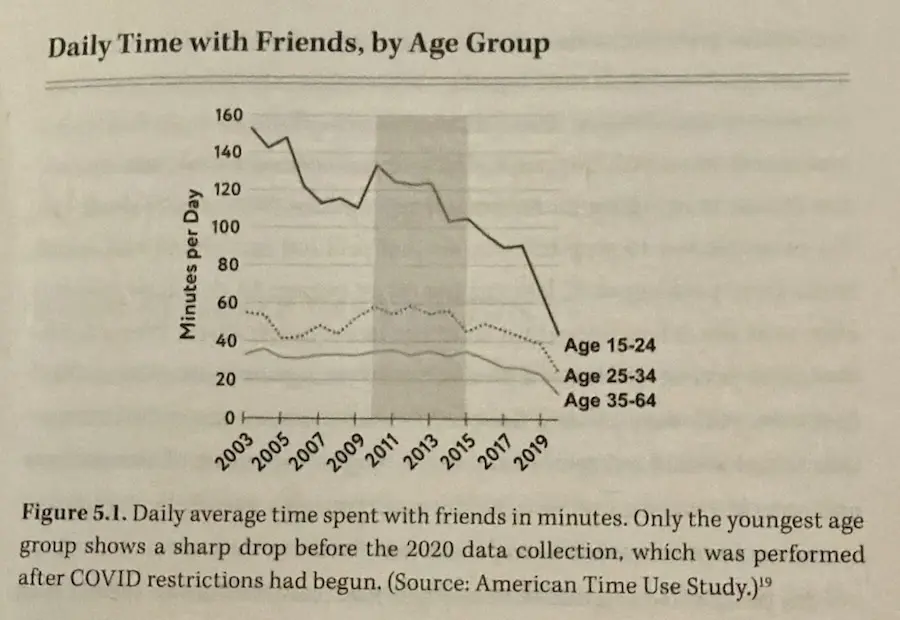
As Haidt describes it, girls are particularly vulnerable because:
1. Girls are more affected by visual social comparison
2. Girls aggression is more relational
3. Girls more easily share emotions and disorders
4. Girls are more subject to predation and harassment
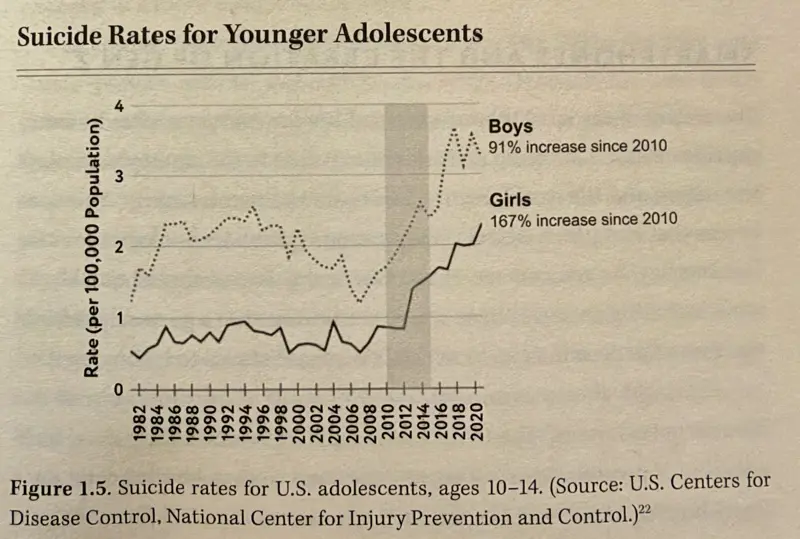
The starkest statistic Haidt provides is the rise in suicide rates for those aged 10-14 - that we lose our young people like this, and that it’s increasing at such an alarming rate is troubling. Let me be clear, it doesn’t necessarily mean it’s social media to blame, but it sure tracks well with the rise of the smartphone and later social media.
And we don’t need to go far outside ourselves for anecdotal evidence. As a man. I see the rise of the “manosphere” and elements such as anger, economic disparities, lack of opportunities and other ills making boys and men turn further inward and to addictive online media. This is creating angry apathetic young men with too much time on their hands.
Scott Galloway, a writer and podcaster that has spoken exhaustively about men’s health says this in his book Notes on Being a Man: “a large and growing cohort of bored, lonely, and poorly educated men is a malevolent force in any society, especially this one [USA].” I tend to agree. He also says to his sons later, “[the] enemy of masculinity is isolation,” “participate in as many collectives as possible.”
Brittlestar, a popular Canadian comedian makes a good point in a podcast: “If you ban kids from something, they’re just not going to be prepared for when they get unbanned from it.” He goes on to say “I think a social media ban for kids under 16 is largely unenforceable and maybe it will have negative impacts and that it’ll push kids into the darker, crappier sections of the web…I think it has to be like spoking though, it has to be a cultural ban.”
Unlearn16 or Joanna1, has another take on this. She thinks (after the ban) kids will be able to download social media apps, but just not post to them. While we don’t know who this ban will look in practice, that seems unlikely. Seems to me that, unless you’ve demonstrated you’re old enough to be on a platform, they will not let you access it. Period. She does make a great point in that are we going to ban Discord or YouTube? What really constitutes a social media app? And then Joanna says “instead of banning something, which by the way never works anyways.” That is incorrect Joanna. She goes on to say “We stop pretending like you can shield all the negative impacts of this stuff on to kids, and we start empowering them to deal with the realities of the day.” She’s half-right here because no one is pretending the kids can be completely shielded, but part of the solution absolutely includes empowering kids to understand and use the Internet in safe and smarter ways.
Some companies are pre-empting this. The controls apple will give to parents are insane. A parent can turn a $2,000 iPhone into nothing more than a dumb phone, though who would buy an iPhone to be a glorified telephone+GPS tracker?
There are some that say that parents should bear the burden of this. That parents should step in and stop their kids from using these services. That kids should face consequences inflicted by parents and take the stuff away. While ‘big tech’ does need to be regulated more, the answer probably lies in both the parents while still holding social media services accountable. There is a component to this, much like smoking, where society has to decide that kids should stop this activity and, in time, it falls out of style. Most but the outliers stop doing it, we move on. Savvy, rebellious kids are always going to find a way, guaranteed.
To take it even further, the argument that children will only find ways around this by using burner phones or virtual private networking (VPNs) is valid. What I would say too is that we don’t know what sort of niche social network will exist under the radar that allows kids to get around these policies or corners of the Internet that all school kids know about but the government does not. This is not cats (kids) and mice (government), it’s more like cats and snails. The kids will be 100 steps ahead at any given time. Let’s face the reality too: If I’m an upstart 12-13 year old and see everyone else accessing stuff that is illegal to others, am I going to be able to get a cheap old iPhone or device that opens up the Internet? Yes. Policing this will be a nightmare and I think the experience of Australia’s ban has borne this out. However, the fact that parts of any ban may fail to work (a trusim), does not mean we don’t try.
Another issue is what might kids lose? They may lose the ability to connect with friends the way they prefer (a la Snapchat) and risking further alienating a cohort that is already facing so much. Gander2 user Nicola Woods makes a good point when she said:
I worry a lot about the neurodivergent, disabled, chronically ill, gender non-conforming & otherwise minority teens who will lose access to online support spaces. I worry about our youth growing up without access to important minority voices that weren’t heard before the internet. I’d be ok with 12 [and under]
Will these support spaces go away with a ban like this? I expect these effects could be devastating. I do also expect that most, if not all of these avenues are not solely based in social media access.
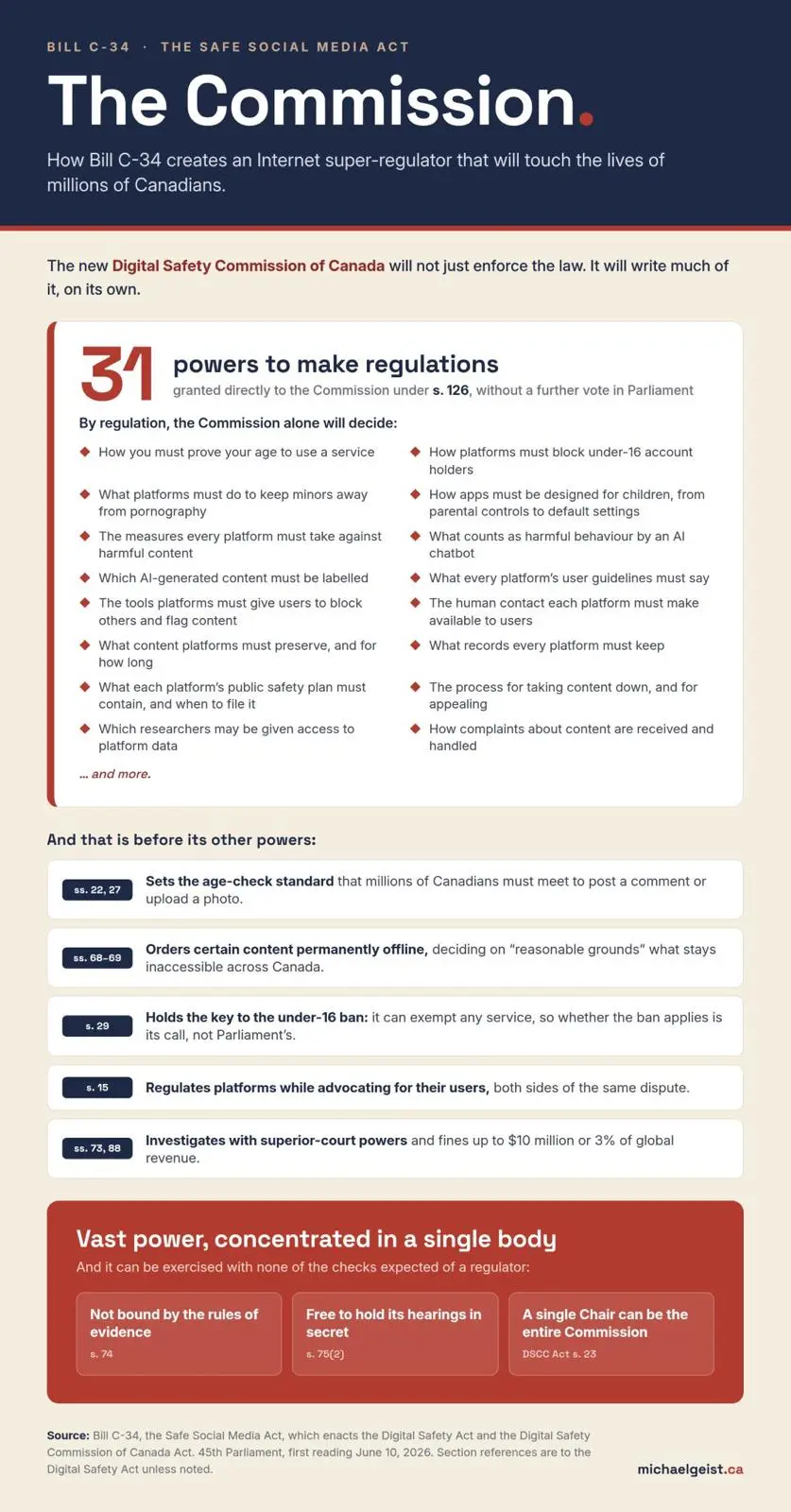
Back to bill C-34, there are a ton of troubling things about this legislation. Leading this charge is Michal Geist who rightly points out that for any age verification system to be useful, everyone has to be verified. This means a massive handover of private information like identification where none of that is warranted now. The potential for this to be misused is enormous. I also think of those adults that wish to remain anonymous online, if social media services force those people to identify themselves, it could potentially put those people in danger. For those keen to disagree with anonymity online, think of people in danger of stalking or whistleblowers - anonymity could a life or death matter.
The Canadian government has a poor track record for technology regulation in general. They failed to previously being about a ban on social media and caused considerable grief for users when they created an out-of-touch bill that forced online platforms to pay for linking to news. The essential idea of protecting children from social media is a good one, but the government is going to need to respond to the public better and adjust the legislation fast to find a way that balances all sides of this.
This doesn’t even get into the waste of creating another super powerful government body that has vast, perhaps too far-reaching and open, powers. Canada needs to be reducing the size of government, not creating new branches of it.
I am also a father to 10 month old boy. I sense that the right thing is to delay his access to a smartphone as long as possible. This could go well into his teens but I know that will likely be impossible in practice3. When he’s old enough, what is the social networking landscape going to look like? As parents, we may fail to protect him from the worst the world has to offer. Subjectively, I see the the landscape of social media as dangerous for his mental health. Twitter/X makes it easy to access a ton of graphic videos and people act horribly on social media (often because they can). Just recently, a woman was errantly thrown from a bridge in Brazil at a bungee ride; the people working there forgot to attach the safety harness and the 21 year-old women tragically fell to her death. Recorded in full, this video was then made available on every social media platform, unedited. Sometimes the worst is blurred out, sometimes the video cuts just before the woman hits the ground. In other cases, some have taken to saying the video was fake. If you were a child, you’d be inundated with this event from multiple angles and in graphic detail including every AI-slop created version after it until the next gruesome event comes along.
The question I ponder is how to protect my son until he is ready think critically about what’s out there. Just like a late night festival where anything can happen, it’s prudent not to take him into that environment until it feels like he has the tools to think clearly, digest the chaos, be responsible, and enjoy himself. I understand that doesn’t coincide with a specific age, but that’s where parental teaching and guidance pays a huge role. As he ages, he’s going to gain agency and learn to circumvent anything I or the government tries to do. The hope is his tool chest of critical thinking has grown with his age.
If by then, social media is boring and socially unacceptable, that is the only chance for something like this to succeed. Of course, a worse thing may take its place. I doubt anyone today has ultimate control over that outcome, but what we can do is not give in to the fear, uncertainty and doubt. Finding a path that protects young minds better while preserving the rights of everyone is a a health imperative. The addictive Internet complex is not going to do it for us. Parents can’t do it alone. The government will have to play some role. The way forward may include all of them.
-
I sat a few tables away from her in a coffee shop one time. She was just like she is online. ↩︎
-
Gander is a Canadian social media site. It is currently an invite-only service. ↩︎
-
What’s a smartphone going to even look like in 8 to 10 years? ↩︎